| 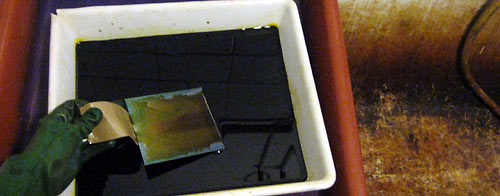
In intaglio printmaking, depressions
are scratched, cut or etched into a flat metal plate. When the plate is
inked and wiped, the ink remains only in the depressions. Printing the
plate onto a humid paper with a press creates a side-inverted image.
Printmaking techniques basing on the same principle are engraving and
mezzotint (see below).
History
The development of intaglio printmaking is connected to the
beginning paper production in Europe in 1390 and the work of goldsmiths
and armourers. Cutting and engraving metal was common for a long time as well
as inking these engraved depressions for decoration. From recording designs
by rubbing engraved motifs with or without inking onto paper it was only a short
step to using this technique as a way of artistic reproduction.
The first copper engravings were done probably around 1430.
In engraving, fine lines are cut into a brass or copper plate with burins from
steel. Intaglio developed some decades after woodblock printing, resulting from
the fact that it was more complicated than woodblock printing, which in addition
followed the pre-stage of cutting seals which had already been known for some
time. Compared to the popular woodblock prints, intaglio prints found their
audience rather among aristocrats or wealthy citizens, probably resulting from
the higher refinement in technique and visual impression. Intaglio prints were
also in demand as this way art works could be collected at reasonable prices.
Compared to woodblock prints, the images shown in the intaglio print were far
more secular.
Engraving developed first in the South-Western
part of Germany and in Switzerland. Though
there were influences on Asian printmaking, intaglio is rather a European
printmaking technique. Drawing was part of the goldsmiths training, and thus
the first engravers were goldsmiths, today no longer known by name. First outstanding
engravers were the "Master of the playing cards" and the "Master
E. S." among others.
For a while the technique was practised mainly by artists
as Martin Schongauer from Germany and Hendrik Goltzius and Lucas van Leyden
from the Netherlands. The engravings of this time were showing both religious
and mundane images. While the German artists leaned stylistically closer
on the middle age at a higher technical standard, the Italian Renaissance
artists as Andrea Mantegna and Maso Finiguerra created prints which appeared
more "free".
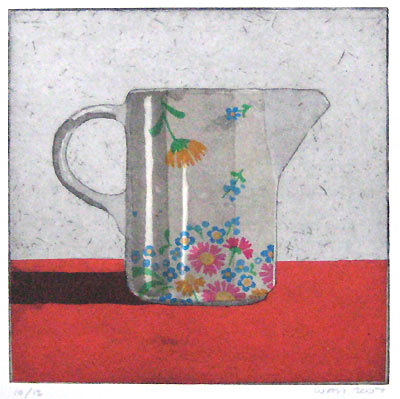
Bill Harrison (USA), "Mug from the GDR", line etching and aquatint
with chin colle (please see below)
In the second half of the 15th century, the technique of drypoint
emerged. Lines were scratched into the plate directly with a sharp needle, thus
creating a burr on both sides of the line. A first artist using this technique
was the "Master of the house book", who was working in Germany between
1465 and 1500. As the emerging burr was compressed again after some printings
and only a few copies could be pulled, drypoint was often practised by artists
for re-working already cut or etched plates.
As in woodblock printing, Albrecht Dürer
(1471-1528) from Nürnberg was an artist of highest significance also in
engraving. From travelling in Italy familiar with the Italian Renaissance engravings,
he created prints which brought this technique to a completely new level of
art.
Temporarily, he also worked in the new technique line
etching, emerging in the end of the 15th century. Lines were
now not cut or scratched into the plate, but drawn into a wax layer on
the plate and later etched in an acid bath. This made drawing much more
easy and spontaneous. First artist who were working with line etching
were Urs Graf from Switzerland and Daniel Hopfer from Augsburg, Germany.
Line etching was also combined with engraving. In the 17th and 18th century,
line etching was used by painters and drawers as Rembrandt und Claude
Lorrain or later Tiepolo and Piranesi.
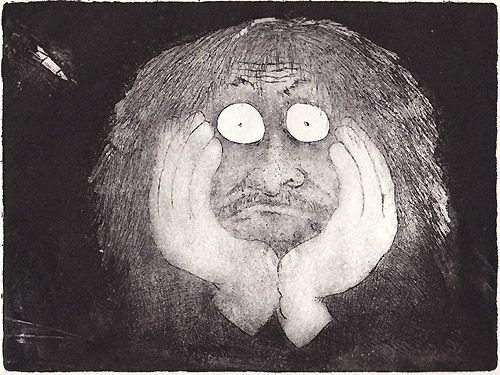
Klaus Stuttmann (Berlin), "No Title", line-etching
with aquatint
Engraving however was practised since the mid
17th century predominantly by professional engravers. These
were mainly ordered by publishers or artists to copy already existing images.
Engraving was used for reproducing paintings, for book illustrations or producing
maps.
In the mid 17th century also a technique called aquatint
developed. It allowed creating even areas of different tones. However it was
common only in the 18th century. A master of aquatint was Francisco Goya, who
as the Spanish court painter expressed the societies dark side in his "Caprichos".
With the rise of wood engraving in the 19th century and the
invention of lithography and photography, copper engraving became less important.
Since the mid 19th century, a change in the evaluation of prints
took place and the term of "original print"
was born. Printmaking artists confederated in associations. Mostly these
were painters, who also made prints, creating their plates by themselves
and sometimes even printing them, treating the processes rather creatively.
For the first time, prints were signed. At first, artists mainly preferred
to create intaglios and lithographs, often in form of book or portfolios
on order by publishers. Artist creating these new "original prints"
were in France artists of the "Barbizon School" and some of
the Impressionists, in Germany Impressionists as Liebermann or Slevogt,
also Käthe Kollwitz und later the Expressionists with Beckmann, the
"Brücke" artists and many artists who were published by
the committed art dealer and publisher Paul Cassirer in Berlin. He also
contributed to a new prime of printmaking in Germany by publishing in
1909 Hermann Strucks book "Die Kunst des Radierens" (The Art
of Intaglio), which made the technique available to a bigger audience.
Technique
Engraving
Fine lines are cut with steel burins from various profiles
into a plate from copper or from brass, which was mainly used in the early
years. The burr which emerges on both sides of the cut line is later removed
with a scraper.
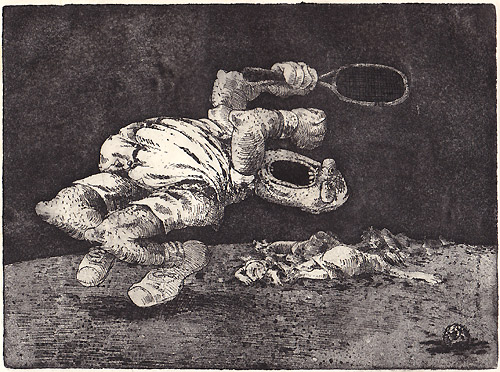
Klaus Stuttmann (Berlin), "No Title", line-etching
with aquatint
Drypoint
Drypoint is the easiest and most direct technique in intaglio.
With a sharp needle from steel lines are scratched directly into the plate,
thus creating a depression with burrs on both sides. When being inked, the ink
remains not only in the depression but also around the burrs. The printed line
has a special soft and velvety appearance. As the burrs are compressed during
printing, only small editions can be printed.
Line etching or hard ground
The plate is covered with a thin layer of wax or varnish which
hardens after drying. By drawing lines with an etching needle the covering layer
is removed. During etching in an acid bath the opened areas are eaten by the
acid and this way become deeper. The lines thickness and deepness depends on
the duration of etching, the chosen acid and the used ground.
Vernis Mou or soft ground
The plate is covered with a thin layer of a special wax which
doesn't dry but keeps soft. A thin paper is put onto the laminated plate which
can be drawn on with various drawing tools like pencil, crayon or a brush handle.
Also objects like leafs can be pressed into the soft ground. During drawing
the wax sticks to the paper and the plate's metal surface is uncovered. In the
acid bath, these areas are deepened. This technique reproduces the special qualities
of the used drawing tools perfectly.
Aquatint
For etching grey tones, a kind of raster is applied to the plate
in form of many small acid-resistant grains. In traditional intaglio this is
done by melting fine resin or asphalt dust grains onto the plate. Today, also
acrylic can be used by spraying it onto the plate.
In the acid bath, the acid bites between these small grains. The longer the
plate is being etched, the deeper the depressions between the grains will be,
thus holding more ink when being inked and displaying a darker tone when the
plate is finally printed. To produce tones, parts of the plate are covered with
acid-resistant varnish during etching steps.
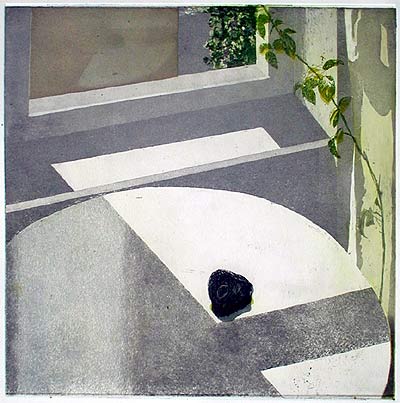
Fig.: Aquatint (four plates with five colours), 2003
Open bite
When open areas of the plate are being etched in acid without
an aquatint grain, in these areas the plate becomes just thinner. During inking,
the ink remains only in the edges of these areas. So areas etched without aquatint
show just lines in the final print.
Mezzotint
In mezzotint, the process is rather negative, working
from dark to light. The first working step is roughening the plate's surface
evenly with a rocking tool. After that, parts of the plate are polished
with a scraper, this way levelling the plate's depressions.
Chin colle
Chin colle is a collage techniques. Thin pre-glued paper is positioned
on the inked plate. During printing with a press the plate prints onto
the paper and at the same time fastens it onto the actual printing paper.
Bibliography
Brown, Kathan: "ink, paper, metal, wood", Chronicle
Books, San Francisco, 1996
Mayer, Rudolf: "Gedruckte Kunst", VEB Verlag der Kunst,
Dresdnen, 1984
Sotriffer, Kristian: "Die Druckgraphik – Entwicklung,
Technik, Eigenart", Schroll & Co, Wien, 1966
Saff, Donald and Sacilotto, Deli: "Printmaking: History
and Process", Wadsworth Inc Fulfillment, New York, 1978
Wye, Deborah: "Artists & Prints – Masterworks
from the Museum of Modern Art", The Museum of Modern Art, New York, 2004
|