|
Screen printing, also called serigraphy, means printing by squeezing ink through
the meshes of a fine fabric, which is stretched over a frame, thus producing
even layers of ink. While some areas of this so-called screen are blocked by
the use of various techniques, only the open areas are printed. This allows
creating a wide range of forms and effects by cutting, painting and using a
technique of photo transfer.
While screen printing is and was mainly used commercially, it is a printmaking
technique which offers artists numerous creative options without necessarily
affording huge equipment. The advantages are the option to print on various
materials besides paper, the fact that screen printing is quick and comparably
cheap, even when working in huge sizes, the easy way to reproduce photographs
or outprints, and the fact that the print does not appear side-inverted.
The term "silkscreen" comes from the times when the
fabric used for screenprinting was made from silk. Today screens are made from
polyester mainly.
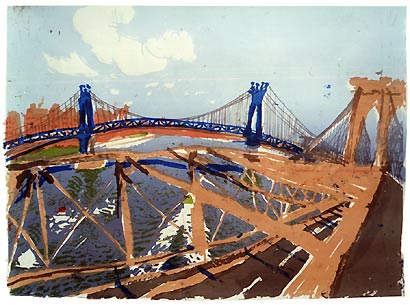
Screen print, New York 1995
History
The use of stencils is one of the oldest creative techniques.
Already in prehistoric caves, images of hands can be found which were created
by blowing pigment over hands with blowtubes. In China and Japan, stencils were
used for decorating textiles already around the 6th century
or even earlier. In Europe, woodblock prints were handcoloured
by the use of stencils during the middle age.
Still the problem remained that stencils did only allow using the inner parts
of cut areas when keeping "bars". A first solution
to solve this problem was the Japanese development of fixing two-layered paper
stencils with hairs or silk threads in a paper frame, called the technique of
katazome, in the 17/18th century. Rice paste was pressed
through the stencils' open areas, which in dry state during dyeing prevented
the covered areas from absorbing dye.
After Japans opening in 1853, this technique was presented in
the Western world and caused global admiration. Probably without being influenced
from this, screen printing with fabric from silk and cut paper stencils was
already practiced in France for textile printing. The first
patent for a screen printing technique was awarded in England in 1907. While
in the beginning, the ink was pressed through the screen's meshes with a brush,
around the turn of the century the squeegee became the preferred
tool for printing.
In the aftermath, the technique of screen printing was enhanced
in the USA, till the involvement of a photo-sensitive emulsion.
The young printmaking technique was used mainly for commercial purposes like
advertising. In the 1930ies, artists in the USA started to use screen printing
as an artist medium. In these times, the term "serigraphy" was used
to define screen prints done by artists. In the 60ies, screen printing had a
prime: with its vicinity to the advertising aesthetics, the intense colours
and the option to reproduce photographs it was the prefect medium in Pop
Art.
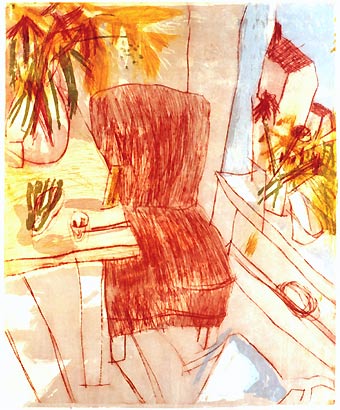
Screen print (grey, blue, purple, green) with drypoint intaglio (red, yellow),
Berlin 1995
Technique
Screens are frames holding fine fabric, in earlier times from
silk, today mainly from Polyester. Screens with from wooden and metal frames
are available, but screens can also be built easily (from wood by gluing pieces
or from wooden or plastic plates by sawing out the inner area) and be covered
with screen printing fabric.
Screen printing fabric is available in various grades of fineness,
depending on the material which will be printed on and the motif.
Printing is done with a squeegee, a rubber ledge with a wooden
or metal handle. Squeegees are available in various grades, with soft squeegees
being used for simple forms and hard squeegees for fine and detailed images.
For simple screen printing, every sturdy table works as a
working area. During printing, the screen has to be fixed on the table to allow
tilting it. Metal screens are fixed with special screen printing hinges; wooden
screens can be fixed with ordinary hinges. Small and light screens can be fixed
with tape.
For perfectly even printing results a vacuum table is useful
which prevents the paper from sticking to the screen after the printing. A vacuum
table can be build easily from an air-proof box with wholes in the printing
area and a vacuum cleaner or pump for exhausting the air.
Printing process
Before printing, the paper is positioned under the screen and the position
marked to guarantee that all papers are positioned on the same spot during printing.
For printing, the ink is poured on the screens front edge and spread with the
squeegee to the rear of the screen, thus filling the screens meshes evenly with
ink. By pulling the squeegee over the screen, the ink is pressed through the
screens open areas onto the paper.
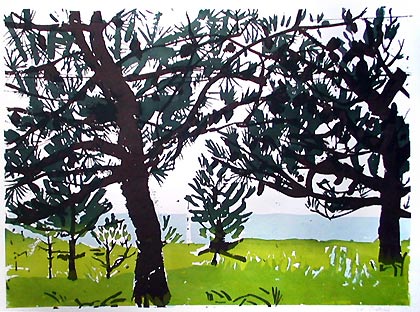
My first screen print, South Korea 1994
|