Woodblock
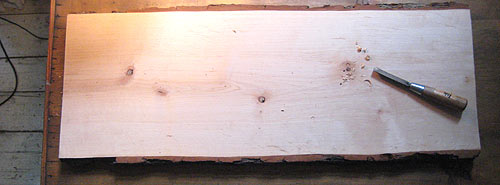
In woodblock printmaking, the parts of the wooden block which
should not appear in the final print are removed from the block by cutting them
away with knifes. For printing, the remaining raised parts of the block are
inked and a paper is rubbed on it by hand with a tool or the paper is printed
with a press, thus creating a side-inverted impression. This method, which also
includes the techniques of wood engraving and lino cut, is called relief
printmaking.
History
China
Woodblock printing, the oldest printmaking technique,
was born in China. Preliminary stages were the techniques of cutting or
shaping stamps and seals. The most important precondition for the development
of woodblock printmaking was the creation of paper which
dates to 105 AD in China.
A first early "printmaking" technique was stone rubbing.
Stones, engraved with calligraphies, were closely covered with humid paper.
When the paper was dry, ink was spread onto it, leaving the engraved parts
white.
Stone rubbing lead to the development of woodblock printmaking,
or both techniques emerged at the same time. The oldest remaining woodblock
printmaking book in China, the Diamond sutra from Dunhuang, a scroll with
a beautiful drawing as frontispiece, dates to 868 AD. It is done in such
a perfect way that a much earlier development is very likely. The oldest
remaining woodblock print was found in a Korean temple which dates to
751 AD. Strongly influenced by China were the prints of the Buddhist texts
"dharani" in Japan in 770, though it is not known from which
material the plates were made. In the first centuries in China woodblock
printmaking was used mainly for the reproduction of Buddhist texts and
images, but also secular purposes.
 More about Chinese woodblock printmaking

Gesine Janzen (USA), "Homemade Treehouse", woodblock
printed with water-based inks, 2002
Europe
In Europe, woodblock printmaking emerged much later. Printing
on fabric with wooden stencils was common for centuries, however, also in Europe
woodblock printmaking started with the beginning paper production
in 1390. Thus the first woodblock prints were created around 1400. They were
mostly done in collaboration work of skilled craftsmen. A draftsman created
a design on paper or drew the design directly onto the block, which was cut
by a cutter and later printed, and often also hand-coloured, by a printer.
Mainly pear wood was used, for very detailed designs also the
hard boxwood, for large areas the soft basswood. The pointed knife for line
cutting was held like a pencil, the rest of the wood was removed with gouges
and chisels. In the beginning, printing was probably done by stamping the block
onto the paper. More practical was placing the paper onto the block and rubbing
it with a tool. Later, especially after the invention of printing type, presses
were used for printing. In the beginning both water-based ink and oil-based
ink was used, later the use of oil-based ink prevailed.
The first woodblock prints were playing cards and single sheet prints,
often images of saints. Stylistically, woodblock printing starts in Europe in
the end of the high Gothic, and is showing its clear spiritual
drawn line.
The single sheet prints were followed by block books
around 1430: several printed single sheets, bound to books and with hand-written
text, which later was cut into the block. Favourite themes of the block books
were the "Biblia Pauperum" (bible of the poor), the "Totentanz"
(dance of death) or the "Planetenbücher" (books of planets).
With Gutenbergs invention of typography in
1440, the creation of the block books ended, as text and image were now separated
and the relation between text and image changed completely. While in the block
book the focus was on the image, it was now on the text. Printing was now done
with the help of a press, while the height of the block was adjusted to the
height of the lead letters.
Around 1500, woodblock printmaking had its prime as a way of
book illustration. Its centres were Germany (Augsburg, Ulm,
Nürnberg) and the Netherlands. One of the most important works of this
time was the "Schedelsche Weltchronik", which was illustrated with
2000 woodblock prints. It was printed by around 100 printers with the help of
24 presses in Nürnberg.
In the second half of the 15th century, woodblock printmaking
underwent a strong change: with a lively way of drawing with hatching more realistic
impressions of space and light could be achieved. Woodblock printmaking
became an art form and prints of highest artistic stage were created by artists
like Hans Burgkmair, Lucas Cranach, Hans Baldung Grien and Lucas van Leyden.
The cutters, which cut these challenging designs got more appreciation and sometimes
cut their seal into the block.
With Albrecht Dürer (1471-1528) from Nürnberg the
woodblock print came to a new level of sophistication. His big woodblock sequences,
especially the "Apokalypse" with its monumental, dramatic compositions,
made him famous with their forcefulness and brought the woodblock print to new
prominence.
With the baroque era and its rather courtly
art, woodblock printmaking became less important. Engraving and intaglio became
the mainly used printmaking techniques in Europe.
In the mid 18th century, the first wood engravings
emerged in England. Finest lines were engraved into hard woods like boxwood,
often prepared as end-grain blocks. Wood engraving was mainly used for book
illustration, but also drawings of artists were reproduced this way, for example
Adolf Menzels portfolio "History of Friedrich the Great". With the
development of photographic techniques for printing, the elaborate engraving
became uneconomic.
The new artist movement to create "original artist
prints", emerging in the mid 19th century, first didn't
include the use of the woodblock print. But the opening of Japan in 1867
and the resulting import of Japanese woodblock prints to the Western world
hat a strong impulse on it. Artists who were working with the woodblock
in a new way were Gauguin, Munch und the German expressionists amongst
many others.
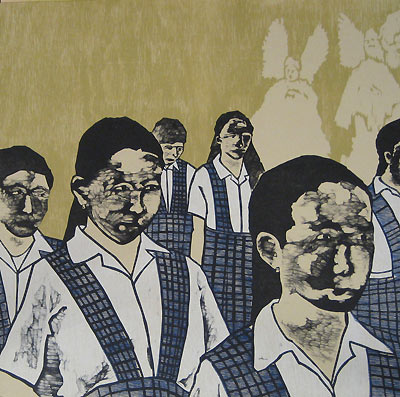
Katie Baldwin (USA), woodblock printed with water-based inks
Technique
Wood
Recommended woods for detailed designs are hard woods from fruit
trees like cherry or pear. Easier to cut is alder wood, or the soft basswood.
Also some plywood can be used, but tends to sliver.
Transferring the design
The design can either be drawn directly onto the block or transferred
with the help of carbon paper.
In the Asian tradition, the design is done on a special thin paper, which is
glued facedown onto the block. Before cutting, the paper fibres are carefully
rubbed off, leaving only the drawing on the block.
Cutting
Several knifes can be used for cutting like pointed knifes for
line cutting (in Japan with thehangi-to, in China with the quan
dao), u- and v-gouges and chisels. Today also some machines make can be
used to make the cutting easier. Knifes have to kept sharp by repeated sharpening.
Printing
In the Western tradition, oil-based ink is used for printing
woodblocks. This is applied evenly in a thin layer with a roller. The paper
is place onto the inked block and hand-printed with a rubbing tool or printed
with a press. The ink sits as a layer on top of the paper.
In
Japanese woodblock printing, water-based ink and a printing paste from rice
starch is applied to the block and mixed on it to an even film. A humid paper
is placed on the inked block and hand-printed with the printing tool baren.
This way, the ink is pressed deeply into the paper.
In
Chinese woodblock printing, the block is inked with water-based ink without
any printing paste and the used paper is dry.
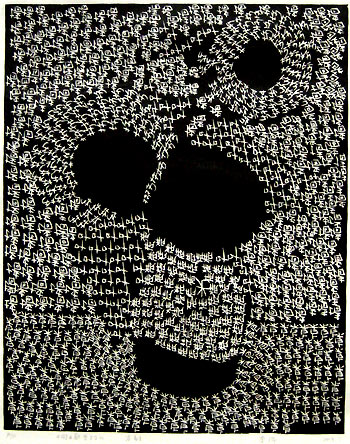
Ri Rui (China), woodblock printed with
water-based inks, 2009
Bibliography
Brown, Kathan: "ink, paper, metal, wood (painters and sculptors
at Crown Point Press)", Chronicle Books, San Francisco, 1996
Mayer, Rudolf: "Gedruckte Kunst", VEB Verlag der Kunst,
Dresdnen, 1984
Laitinen, Kari, Moilanen, Tuula und Tanttu, Antti: "The
Art and Craft of Woodblock Printmaking", University of Art and Design
Helsinki, Finnland, 1999
Sotriffer, Kristian: "Die Druckgraphik – Entwicklung,
Technik, Eigenart", Schroll & Co, Wien, 1966
Saff, Donald and Sacilotto, Deli: "Printmaking: History
and Process", Wadsworth Inc Fulfillment, New York, 1978
Walker, George A.: "The Woodcut Artist's Handbook –
Techniques and Tools for Relief Printmaking", Firefly Books, 2005
Westley, Ann: "Relief Printmaking", A & C Black,
London, 2001
Wye, Deborah: "Artists & Prints – Masterworks
from the Museum of Modern Art", The Museum of Modern Art, New York, 2004
|