
|
Chinese Woodblock Printmaking
History
Early pre-stages of printmaking
in China was the use of wooden stamps for reproducing Daoist and Buddhist images
and for printing on textiles, and also the cutting of stone reliefs. The basic
condition was the invention of paper which is dated to 105 A D, when the court
official Ts'ai Lun presented to the emperor a paper which he had, based on earlier
papermaking techniques, signifacantly improved.
Woodblock printmaking started during the
Tang Period (618-907), probably during the 8. Century. A pre-stage at that time
might have been also the technique of stone rubbing, which
emerged around the 7th century, when humid paper was brushed onto a stone relief
and inked in dry state with ink on a tampon. In woodblock printing, a paper
was rubbed onto an inked woodblock with the help of a brush. The oldest remaining
Chinese book, and one of the oldest remaining prints worldwide, is the Diamond-Sutra
found at Dunhuang, dated to 868, a 5m-long scroll with a beautiful
and technically perfect frontispiece showing the preaching Buddha. In the early
days, Buddhist and Taoist images and texts as well as more mundane things like
playing cards and calendars were printed with woodblocks. A huge industry of
governmental and private publishers developed.
During the Period of the five
Dynasties (907-960), big editions of Confuzian classics were printed,
ordered from the court. The Song Period is
famous for the fine prints due to beautiful types and a high
printing quality. Painters, cutters, printers and bookbinders started to specialize
on their crafts. Other major printing projects, ordered by the court, were done
for reproducing classics of literature and religious texts of Daoism and Buddhism.
Papier money and letter papers was printed. In the 10th Century, the bound book
developed from the scroll. For the public, entertaining books with illustrations
were printed privately. Also the  new-year's prints, nien-hua,
emerged, symbolic images for pasting onto doors and in the house.
new-year's prints, nien-hua,
emerged, symbolic images for pasting onto doors and in the house.
Since the 14th Century, multi-colour printing
was done. Printmaking came to a new prime during the Ming Period
(1368 - 1644). A pioneer
of printing with colours, especially gradations, and embossing was the official
and artist Hu Cheng Yen (1582? - 1672?),
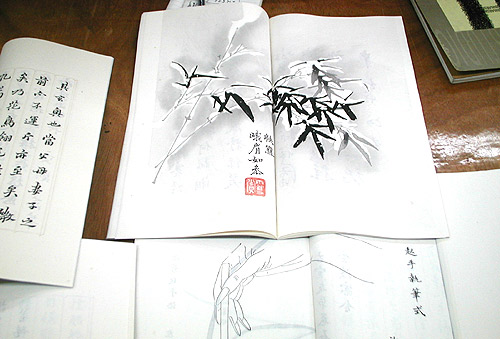
who published the famous "Ten Bamboo Studio Collection"
in 1622 - 1627, beautifully reproduced calligraphies
and ink paintings, and also letterpaper with fine embossings (
images of woodblock prints from
the Ming Period).
The traditional collaboration work changed in the beginning
of the 20th century, when, under the impression of Western printmaking, artists
started to design, cut and print their woodblock prints on their own. In the
30ies, the intellectual Lu Xun initiated a woodblock-print
movement, suggesting to use this technique for political and enlightenment
purposes, presenting prints of the German artist Käthe
Kollwitz. Influenced by this, artists created numerous black-and-white
prints with critical political and social content. Since the 40ies, based on
the political directives coming from the Soviet Union, the woodblock themes
started to lean on the social realism. In the following years
the technique was mainly used as means of propaganda, often practized in teams.
Today, in the lively Chinese printmaking scene, woodblock printmaking is done
in various ways: with the use of oil- and water-based inks, and with several
registration systems.
The following introduction of woodblock printmaking refers to the traditional
woodblock, which is still practiced in some studios.
Technique
Wood
Mostly pear was and is used, preferably of the huge trees from
Shandong, however jujube is used as well.
Transfer
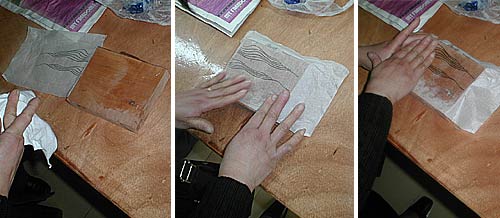
The design is done on a special, very thin paper. For transferring
it to the block, rice paste is spread onto the block and the paper is pasted
with the front side down quickly to the block, by starting on one side and flattening
it to the other. Afterwards the paper fibres on the back of the paper are carefully
rubbed off, until only the painted lines remain on the block.
Cutting the blocks
Cutting is mainly done with a special fist knife, the quan
dao. This knife is custom-made for the users fist. It emerged in the Tang
period (618 - 907).
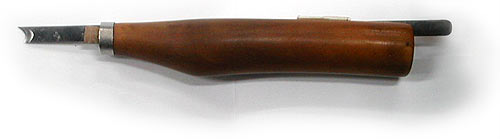
The quan dao is forged in bow form with two points. With
the front point the lines are cut, with the back point the remaining wood is
scraped or pushed away.
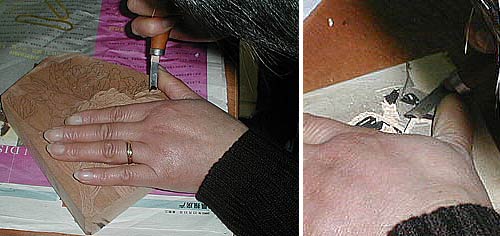
This way very detailed parts of the block can be cut exclusively with this knife.
For less detailed parts gouges are used additionly.
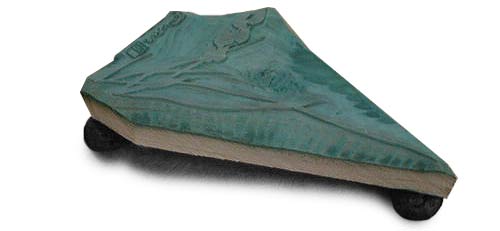
As opposed to Japanese and Western woodblocks, the different
details of a design are not cut into a single block but distributed to several
small blocks, which are fixed in the right position on the printing table.
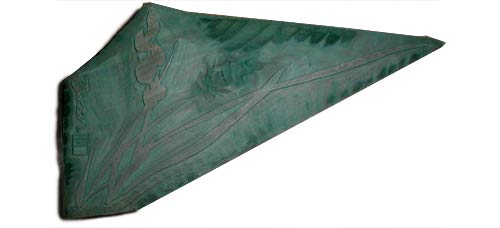
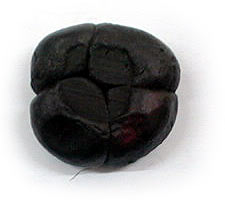
This is done with a resin, which is flexible while being warmed,
and keeps the blocks in place after hardening.
Printing
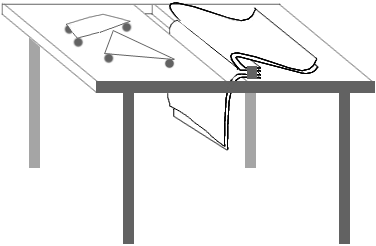
For printing a special printing device is used – a table
with a gap. The papers are attached on the edge right beside this gap under
a slat and then flipped over to the right. Left from the gap, the blocks are
fixed onto the table with the resin. The right position of the blocks is found
by touching the blocks through the first of the attached papers.
For every printing the blocks have to be inked with a special printing brush
(please see below). Sometimes the ink is diluted with another brush for creating
gradations. After inking, a paper is flipped over the blocks and rubbed with
the hand printing tool (please see below). The inks condition (concentrated,
diluted, very wet, almost dry, pasty) and the pressure during printing influence
the result.
After printing the paper is dropped into the gap. When all the papers are printed
and dried, the printing of the next color can start.
Printing is done on dry paper or silk.
Traditionally, inks made of plants are used, which are diluted
to the wished intensity with water.
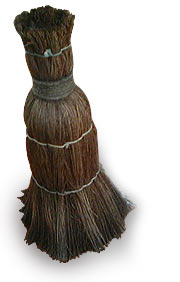
The printing brush is made from palm leaf fibers.
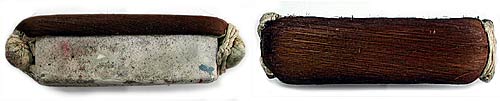
The tool for printing is a piece of wood covered with palm leaf
fibers and horse hair on top.
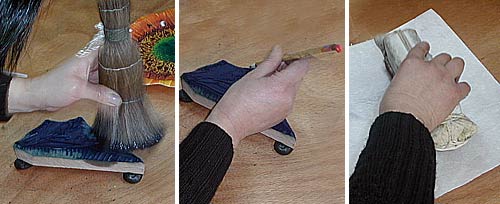
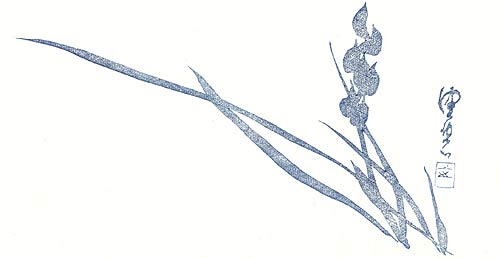
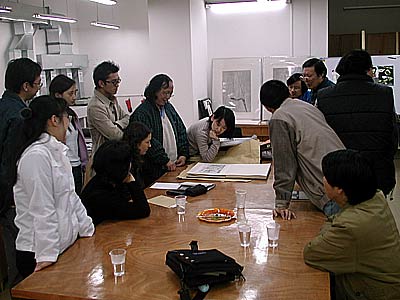
I want to thank Mr. Lu Zhiping for organizing the demonstration
at the Peninsula Art Center Shanghai and Mr. and Mrs. Lu Qinghua for demonstrating
the techniques.
Eva Pietzcker, 2003
Bibliography
Farrer, Anne (Hrg.): „Chinese Printmaking Today: Woodblock
Printing in China 1980-2000”, British Library Publishing Division, 2004
Hunter, Dard: „Papermaking Pilgrimage to Japan, Korea
and China”, Pynson Printers, New York, 1936
Tschichold, Jan: “Die Bildersammlung
der Zehnbambushalle“, Holbein Verlag, Basel, 1953
Twitchett, Denis: „Printing and Publishing in Medieval
China”, Frederic C. Beil, New York, 1983
|
|