Japanese Woodblock Printmaking -
moku hanga
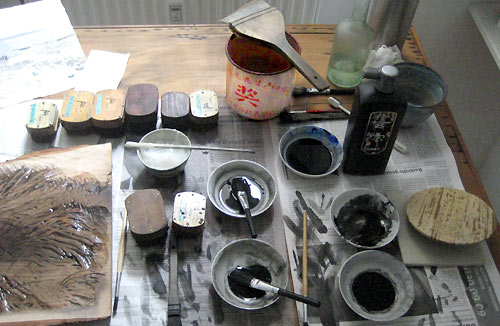
The Japanese technique of woodblock printmaking is very different
to the Western technique. While in the Western tradition, oil-based ink is applied
with a roller and printed onto the papers surface often with the help of a press,
however in the Japanese tradition, the water-based ink is applied with a brush
and, while being printed by hand, is pressed deeply into the absorbent Japanese
paper.
History
Woodblock printmaking came to Japan from China
probably around the 8th century. At that time the two countries were connected
by an intesive cultural exchange. Probably under Chinese consulting, in 770
the print of some of the first known text prints was finished: the dharani,
ordered by Empress Shotoku, Buddhist verses, each stored in a small wooden pagoda.
However, it is not proven from which material these plates were made.
In the beginning, woodblock printmaking was done only in Buddhist monasteries,
for the purpose of reproducing Buddhist texts and images, later also for books.
Only in the beginning of the 17th century printing was also done in private
studios. The first prints were just black-and-white.
Japanese woodblock printmaking had its prime during the Edo
period (1603-1868). After centuries of civil war, this was a time of
inner peace. In 1603 the sovereign Tokugawa Ieyasu had won
an important battle and became the new shogun. This position was kept by members
of his family until 1868. He choose the fisher village Edo (today Tokyo), where
he already had installed his headquarters, as the new capital, far from the
Emperors court at Kyoto. The new capital grew very quickly and attracted crafts-
and salesmen. A rich middle class developed with an intense cultural life, especially
because the restrictive regime refused its citizens any access to political
power. Theatre, sumo and brothels got very popular. The artists expressed the
spirit of this new time in their images, the ukiyo-e,
which means "images of the floating world". In the middle of the 17th
century, the artist Moronobu as one of the first created a single sheet woodblock
print. These new, reasonable priced prints became very popular.
The woodblock prints were created in teamwork
of publisher, artist, cutter and printer. Also involved were craftsmen like
papermakers.
The first just black-and-white prints (sumizuri-e)
were soon coloured by hand (sumizuri-hissai). The available
colour palette soon became bigger, and also metal dust was used. In the first
half of the 18th century, the printers began to print from two or three plates
and soon the cutting of registration marks, the kento,
were invented. This technique made it possible to print from many plates with
high accuracy. The artist Harunobu was one of the first who brought this technique
to its prime by designing prints from more than 20 plates. These magnificent
new prints were called brocade images (nishiki-e).
There was a big variety of themes. In the beginning, legends
were the main theme, and images from the popular kabuki theatre. The
artist Harunobu designed prints showing scenes of everyday life. Utamaro was
famous for his fine portraits of beautiful women. In the end of the 18th century,
landscape and animals too became themes of artists as the masters Hokusai und
Hiroshige.
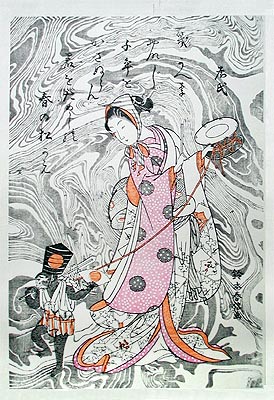
Ill.: Copy of a woodblock print from Harunobu Suzuki, designed
in the middle of the 18th century
In 1853, American ships forced Japan to open her harbours. This
resulted in strong social changes. The shogun had to resign and emperor Meiji
(1868-1912) was enthroned. Japan now began to open herself to the Western culture.
In opposite to the time before, when contact with Westerners was strictly forbidden,
this now was strongly supported. Western printmaking techniques were introduced
in Japan and the traditional woodblock print lost its meaning. It also hadn't
been considered to be highest fine art in the Japanese society. But the prints
which were exported to Europe caused big admiration there and strongly influenced
art movements as the Jugendstil and the new poster movement, and also
various single artists as van Gogh, Gauguin and many others. In Japan meanwhile,
artists, who came back from studies in Europe, got influenced from the way of
European printmakers to design, cut and print their prints by themselves. This
resulted in the sosaku hanga movement ("creative
print"), which's artists took the process of creating a print completely
in their own hands and developed prints of modern expression including abstract
images. On the other way, the shin hanga movement ("new
print") was initiated from publishers like the famous Watanabe, who wanted
to keep the traditional woodblock print alive by publishing prints which were
done in collaboration work as in the early days and resembled them also in their
themes.
Technique
The wood of the traditional Japanese woodblock is the wild cherry.
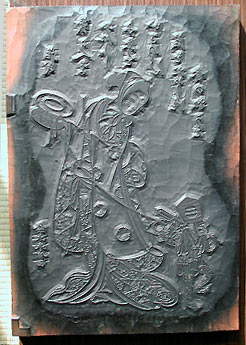
Ill.: This woodblock was cut from cherry wood about 70 years
ago after a motif from Harunobus (print see above). The kento marks are visible
on the left side of the plate.
The block is courtesy of Mrs. Keiko Kadota, given from master printer Tadashi
Toda
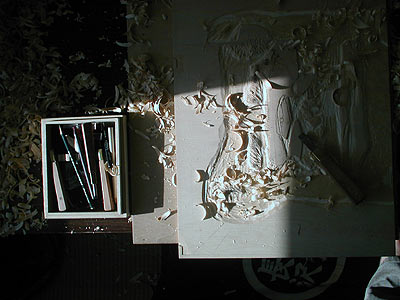
Cutting is done with the help of several knifes and gouges.
The outlines are cut with the line knife hangi-to. This knife is hold
in the fist and allows to cut with the highest accuracy.
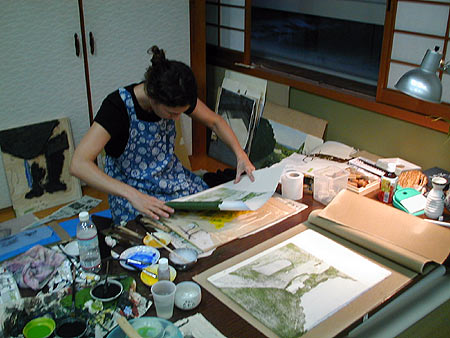
Printing is done by hand. Ink and printing paste are applied
to the humid block separately and mixed on the block with a brush to an even
layer. The humid paper is placed into the kento marks and printed by
hand with a circular printing tool, the baren.
Bibliography
Barrett, Timothy: “Japanese Papermaking: Traditions, Tools,
and Techniques”, New York & Tokyo: Weatherhill, 1983
Fahr-Becker, Gabriele (Hrg.): "Japanische Farbholzschnitte",
Taschen, 1993
Hempel, Rose: „Meisterwerke des japanischen Holzschnitts
aus dem Kupferstichkabinett Dresden“, Ausstellungskatalog, Dresden, 1995
Lane, Richard: “Images from the floating World",
London, 1978
Laitinen, Kari; Moilanen, Tuula; Tanttu, Antti: "The Art
and Craft of Woodblock Printmaking", University of Art and Design
Helsinki, 1999
Merritt, Helen; Yamada, Nanako: "Guide to Modern Japanese
Woodblock Prints: 1900-1975", University of Hawaii Press, 1995
Michener, James A.: "Japanese Prints – From the Early
Masters to the Modern", Rutland, Tokyo, 1959
Salter, Rebecca: "Japanese Woodblock Printing", University
of Hawaii Press, 2002
Schwan, Friedrich B.: "Handbuch Japanischer Holzschnitt
– Hintergründe, Techniken, Themen und Motive", Iudicium Verlag,
München, 2003
Statler, Oliver: “Modern Japanese Prints – An Art
Reborn", Rutland, Tuttle, 1956
Yoshida Hiroshi: “Japanese Wood-Block Printing”,
Tokyo, 1939
Yoshida Toshi und Rei Yuki: "Japanese Print-Making",
Charles E. Tuttle Co. Inc., Vermont & Tokyo, Japan, 1966
|