Photopolymer Film
The photopolymer film, a product
of the electronics industry, offers several possibilities to transfer
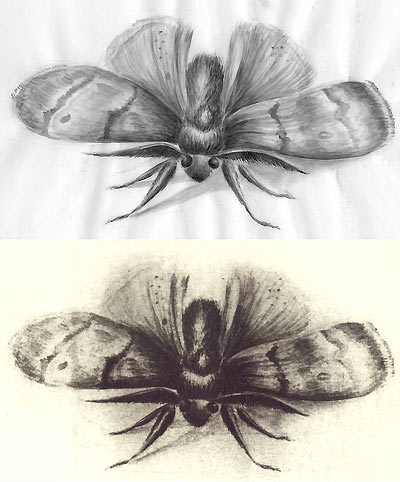
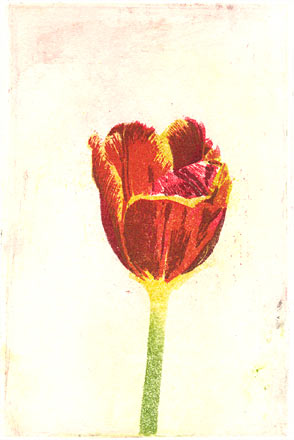
paintings, drawings, photocopies and computer printouts to the plate.
It is a photosensitive film which is laminated onto the plate. The
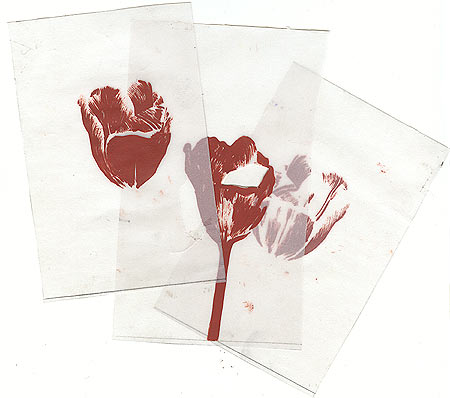
stencils (which have to be drawn or printed on transparent paper)
are transferred to the plate by UV-light-exposure. The exposed plate
is developed in a mild soda solution.
There are two possibilities:
Photopolymer film non-etched
Here the stencil is exposed
to the film with the help of an aquatint screen. The stencil in
this case is transferred including the grey tones. The impression
of this technique reproduces the characteristic features of the
used materials very closely ( chalk, pencil, gouache, etc). The
developed plate can be worked on further by hand with the etching
needle or similar tools. In this case, only the exposed film is
printed, not the plate itself. The film can be removed after printing
and the plate can be reused.
Photopolymer film etched
Here the stencil is transferred
to the plate for being etched later. After the exposure, the film
is developed, enabling the plate to be etched where opaque portions
of the stencil cover the film, thus preventing the film from hardening
under the UV light. Where the transparent parts of the stencil let
the light shine onto the film, the film is hardened and later will
protect these parts from the etch. The advantage of this technique
in comparison with the non-etched type is that after etching the
plate can be worked on with other intaglio techniques. Here it is
also possible to transfer and etch grey tones.

Exposure unit
An exposure unit can easily be built. It should
be a cabinet which can be closed with a light-proof door or curtain.
Upon that the UV-light-source has to be installed in a way that
allows the light to just go down into the vacuum frame, not directly
into the user's eyes. The vacuum frame is located inside the cabinet
itself.
A vacuum frame is a frame that contains a rubber blanket covered
by a glass plate. Via a small hole in the blanket and leading through
a tube, the air between the blanket and the glass plate can be sucked
out by a vacuum cleaner or air pump, creating a vacuum.
For a perfect exposure there must not be any space between the stencil
and the plate. The plate and the stencil are laid on the blanket
and covered with the glass plate, creating a vacuum. While the plate
and the stencil are in close contact from the vacuum, the plate
is exposed to the UV light from above.
Stencils have to be on transparent paper. Photocopies can be made
transparent by rubbing the paper with oil. This has to be controlled
against a light source and later be dried in the drying cabinet,
though not every kind of photocopying paper is suitable for that.
Lamination and Handling
The photopolymer film (which
comes in rolls) has to be laminated to the plate.
The soft, sensitive film is
sandwiched between two layers of protective plastic. Cut a piece
that is a bit bigger than the plate. To remove the soft inner matte
foil easily you should first cut a corner with a knife. The soft
foil can now be torn off. The film is now laid down on the bed of
the press with the open side up. It is important that the bed is
covered by a perfectly even surface (such as a piece of Plexiglas);
otherwise bubbles will emerge on the film after lamination. Before
running the plate through the press the plate should be covered
with plastic to avoid the edges of the film sticking to the blankets.
After lamination the excess film should be removed by using a sharp
hobby knife.
Laminated plates should be stored in lightproof wrapping.
It is recommended to wear gloves while handling the film. The liquid
or dry remains of the photopolymer film should be collected and
be given away to the right authorities.
Back to top
Copyright 2006 Eva Pietzcker and Miriam Zegrer
|