|
This formula was developed by the Berlin artist
 Gernot
Bubenik in 1990. It allows printmakers to independently produce
a low-cost screen printing base. Bound pigments or tempera and gouache
inks may be added. Prints can be overprinted after 15 minutes. You can
use this paste for screens up to 120 T. Gernot
Bubenik in 1990. It allows printmakers to independently produce
a low-cost screen printing base. Bound pigments or tempera and gouache
inks may be added. Prints can be overprinted after 15 minutes. You can
use this paste for screens up to 120 T.
Ingredients
500 ml water
80 g starch
20 ml glyzerine (80%)
5 g gelatine (pulverized)
50-100 ml shellac wax soap
5-10 drops of clove oil
100 ml methylcellulose glue (viscous)
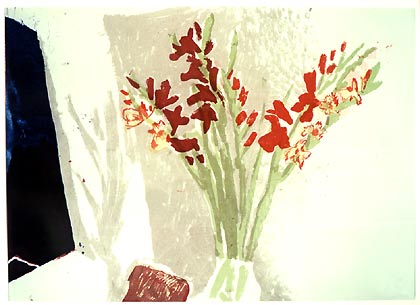
Eva Pietzcker, screen print with self made inks, 70 x
100 cm, 1995
Instruction
Dissolve the starch in a cup filled with 150 ml
of cold water. Pour this into a pot and add 350 ml of cold water.
Place it in a bigger pot with boiling water. Stir the heating mixture
carefully to produce a thick, translucent liquid. Once the mixture
has acquired this consistency, keep stirring for another 5-10 minutes.
Remove the mixture from the water. Pour the glycerine, the gelatine,
(previously dissolved in hot water) and 50-100 ml of shellac-wax-soap
into it while stirring. Add some drops of clove oil to increase
the conservation potential.
When the temperature of the paste is below 60°C, add the warmed
methylcellulose glue.
This paste should be stored in the refrigerator. Stir well before
use, and add water to obtain the desired consistency.
Shellac Wax Soap
Heat 5 parts (volume) shellac wax (broken up) with 5 parts
(volume) of water and one part (volume) Marseille soap until the wax pieces
are dissolved and the mixture has acquired a fine creamy consistency.
Canauba wax is a useful subsitute for shellac wax and the Marseille soap
can be replaced by curd- or olive-oil soap.
|